|
- |
- |
- |
|
||||
|
|
Our grown-up Children
(January
2007) |
||||||
|
The
school was founded on 8th May 1992. Since that time, 15 years
have passed, and our small children have grown up. They have chosen different
paths through life. And often, whenever they need help, they approach us –
like sons and daughters who, even if they are adult, confide in their
parents. This
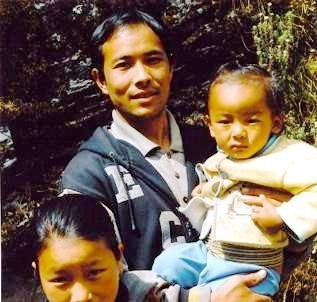
photograph shows Wangchu with his little son. He is
married to his classmate, Maya. As Maya was just helping her parents
harvesting potatoes, she could not join her small family for the photograph. Wangchu is our former cook's son. In 1994, at the age of
17, his father took him to Phugmoche. He had never
been at school before. Phugmoche offered him a
great chance, and Wangchu took it. He has just set
his paper manufacturing plant running which produces hand-made paper out of
the local Lokta plant, Daphne sp. In addition to
that, working as an operator, Wangchu has assumed
the responsibility for our hydro power station.
Phugmoche School consists of two branches:
one which teaches the traditional Buddhism to 23 students, and the other
which offers general education to 23 girls and 23 boys as boarders.
About 35 day-scholars from the neighbouring settlements attend school in
Phugmoche. Quite a
few boys out of Phugmoche's 'first generation'
prepare for becoming monks. Twelve of our former students receive a religious
education in a Tibetan monastic institute in South India. Since Ngawang Tharchin, our young Tulku (a re-born Lama) went to India in 2004, I have been
in regular e-mail exchange with them. It is surprising how well our farmers'
and yak herders' children write English. Among them, Ngawang
Tharchin and Tsewang Rigzin are especially successful. Tsewang
is a member of the editorial team which issues the periodical of their
institute. On
joining the monastery, both young men have taken an oath to themselves not to
return home before having completed the nine grades of their spiritual
education. Almost all of our young religious students have already lost their
fathers or mothers. Tsewang Rigzin
is a cousin of Sonam Dolkar's,
the girl who received the artificial heart valve. Tsewang
thanks us for having given her a new life. He is much concerned about Sonam Dolkar's health. It seems
strange to me that it is through me that those young men contact their
relatives in the far Himalaya. |
|||||||